

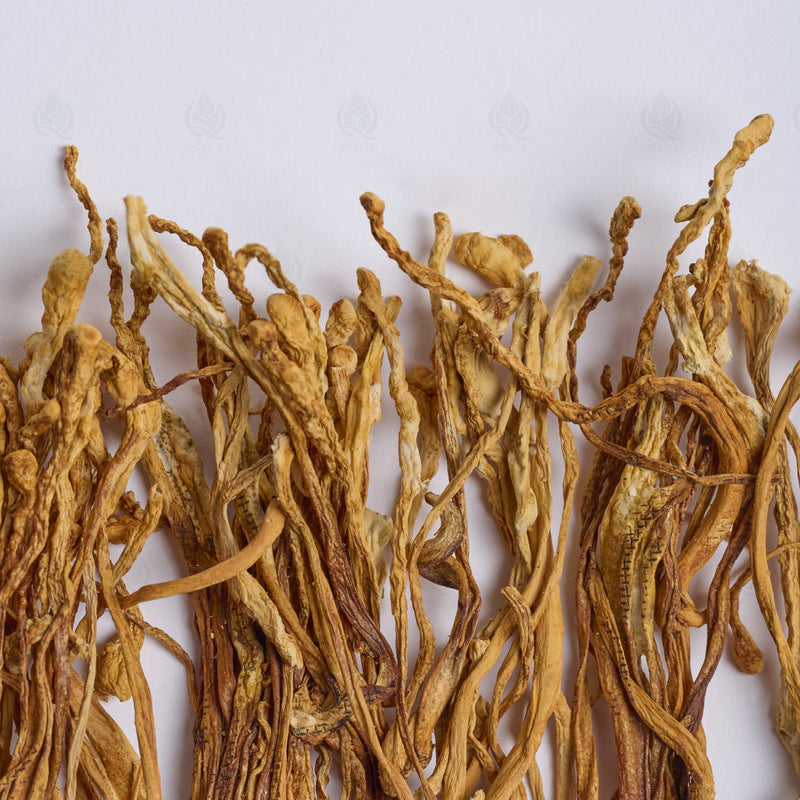
Himalayan cordyceps


Caterpillar Fungus
冬虫夏草Dong Chong Xia Cao·Cordyceps de l’Himalaya
Ophiocordyceps sinensis
- Specialist suppliers based in France
- Dispatched within 24/48h, packed to order
- Kept away from light and moisture

Metal Phase 金
Morus alba
Wu Qijun, Zhiwu mingshi tukao, 1848
According to the classical texts
益肾补肺 止血化痰
Pinyin
Yi Shen Bu Fei · Zhi Xue Hua Tan
Overview
Cordyceps sinensis (renamed Ophiocordyceps sinensis by modern systematics) is one of the rarest and most prized plant-fungi in the world.
Its name 冬虫夏草 means literally “worm in winter, grass in summer”, it describes the organism’s extraordinary life cycle: through the winter, the fungus parasitises and mummifies the caterpillar of a moth of the genus Hepialus buried in the soil of the Tibetan plateaux above 3500 m; in spring, it raises from the caterpillar’s head a small brownish-black stroma that emerges into the alpine grass.
The harvest, done by hand and costly, takes place at the snowmelt. A treasure plant of Tibet, Bhutan and Qinghai, whose prices can reach several tens of thousands of euros a kilo for the higher grades. The 4 g format matches the rarity of the product.
Traditional uses
The tradition places it at the head of the and Yang supplementing registers at once (a great rarity in the pharmacopoeia), and within the Phase register (the deep breath) and the Water Phase register (the Yang foundations).
Traditionally used for constitutions of much-weakened foundations, constitutions under deep rebuilding, and constitutions worn by age or by hardship.
A luxury herb, once reserved for emperors and Taoist elites; today also grown in the laboratory (mycelial forms, more affordable, distinct from the wild stroma, which remains the gold standard).
Preparation and traditional-use quantity
- Slow decoction: 3 to 9 g (with us, the 4 g format corresponds to a short, targeted use), simmer for 30 to 40 minutes
- Supplementing broth: add 2 to 3 stromata to a duck or chicken soup simmered for 1 hour, a luxury culinary tradition
- Fine powder: 0.5 to 1 g of powder taken separately in honey, a thrifty way of using it
- Wild / cultivated distinction: the whole wild stroma (our product) is the gold standard; the mycelial forms grown in the laboratory are ranged close to it but remain distinct
Precautions
A precious herb to be handled with discernment. To be used with care if you are already under a practitioner’s care.
Not for constitutions of settled heat from excess.
Storage: away from light, damp and insects (the stromata can attract moths).
In the same family


White tremella (Snow fungus)
银耳 · Yin Er
7,80 €


Reishi (Varnished polypore)
灵芝 · Ling Zhi
7,80 €


Cordyceps militaris flower
蛹虫草 · Chong Cao Hua
6,80 €


Lion’s mane
猴头菇 · Hou Tou Gu
5,80 €