On 8 August, nothing changes and everything tips.
The sun still burns, the terraces stay full, the ice melts at the bottom of the glasses. And yet, somewhere in the light, a tipping has taken place.The Chinese calendar gives it a name: Lìqiū, the beginning of autumn.
It is the subtlest of turning points, the one the eye does not see, but which the almanac, for its part, had written down long ago.To perceive it takes the patience of those who read the sky as much as the calendar.
A word that runs ahead of time
立 lì means “to establish, to set up, to stand upright”; 秋 qiū is autumn.
Lìqiū is therefore the autumn one sets up, the autumn one institutes, well before it can be seen.
First of the six breaths of the autumn season in the calendar of the twenty-four jiéqì, it falls when the thermometers still read high summer.
That is where all its fineness lies: it names a turning point the body does not yet feel.
The received formula says it aptly: “Autumn announces itself in the air while the Earth goes on ripening the fruit.”.
The sky has already turned; the earth, for its part, is finishing summer’s work.
The signs for those who know how to look
The old almanacs divided each breath into three pentads, three “moments” of five days.
For Lìqiū: first the wind turns cool; then, in the morning, the white dew settles on the grasses; lastly the evening cicadas launch their final song.
Nothing spectacular: a slackening of the light, a coolness that invites itself at dawn, a shadow that lengthens earlier.
The attentive walker feels it first on the skin, in that keener caress of the air in the early morning, well before the first leaf yellows.
In China, Lìqiū carried gestures.
Autumn was “welcomed” (迎秋 yíng qiū) with rites; the first fallen leaf was watched for: 一葉知秋 (yī yè zhī qiū), “a single leaf is enough to know autumn”, says the proverb.
One took up the table again: after a summer of eating little, the custom of 貼秋膘 (tiē qiū biāo) invited people back to more substantial dishes, to “put back the autumn fat”, a pretty way of saying that the pleasure of eating was returning.
A threshold, not a break
Lìqiū still belongs to the Earth phase, to that long end of summer which has not said its last word.
The heat may even redouble: the Chinese give the name 秋老虎 (qiū lǎohǔ), the “autumn tiger”, to that burst of high heat that sometimes prowls after the breath.
Nothing is abolished; a direction is indicated. One leaves the expansion of summer to begin, at a measured pace, the gathering inward of autumn.
It is perhaps the finest lesson of this breath: learning to feel the change before it imposes itself, to read the year like a page turning slowly.
Worth discovering
On the threshold of autumn, the tradition likes sweet flavors and cups without excess.
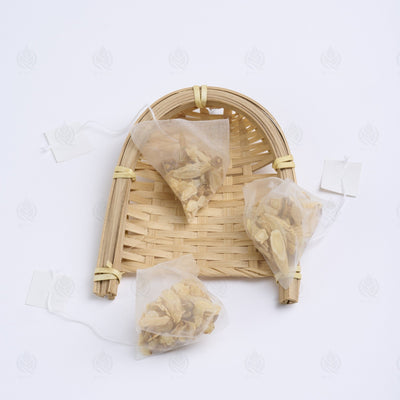
Our Four Treasures Infusion - 四宝茶 (Si Bao Cha) brings together a few simple, round ingredients; it is a drink of transition, neither iced as at the heart of summer nor full-bodied as in winter, to be savored warm when the evening turns cool.
Towards the end of heat
Lìqiū is only a first sign.
A fortnight later, a second breath (Chǔshǔ, the “end of heat”) will confirm what this one has merely sketched: the great heat, this time, will really begin to withdraw.