One morning, the dew no longer beads: it whitens.
On the rooftops, along the edges of the leaves, a fine lace of frost announces that autumn is drawing to a close.
From 23 October to 6 November, the solar calendar crosses 霜降 (Shuāngjiàng), “Frost’s Descent”, eighteenth breath of the year and the last of autumn.
After it, winter.
The last breath of autumn
Shuāngjiàng closes the season.
The almanacs sum it up in a single image: the air turns severe and sets, the dew changes into frost.
The ancients read three signs in it: the jackal lays its prey in store and arranges it as if for an offering, the grass yellows and the leaves fall, the insects burrow deep into their galleries.
It is a threshold breath, one of those that last barely a fortnight yet change the landscape: the orchards empty and the countryside takes on its end-of-year colors.
The light, lower now, lengthens the shadows from early afternoon.
Everything around us seems to be settling its accounts before drawing in.
The stripping bare of Metal
Tradition entrusts autumn to the Metal Phase (金 Jīn), the phase it associates with sorting, with clarity, with what descends and sheds the superfluous.
Shuāngjiàng is its fulfilment: the tree that lets go of its last leaf comes back to the essential before sinking into the rest of Water, the Phase of the approaching winter.
This stripping bare has a very Chinese elegance, that of the scholars who loved autumn for its lesson in sobriety: knowing how to let things fall, to put away, to keep the bone rather than the finery.
Frost, in its own way, is a master of style: it underlines only the contours.
A cup for the threshold of winter
At the table, the season calls for rounder, more amber flavors, to keep company with evenings that fall early.
Black tea, 红茶 (hóngchá) for the Chinese, literally “red tea” after the color of its liquor, is one of them: coppery, mellow, comforting as the day fades.
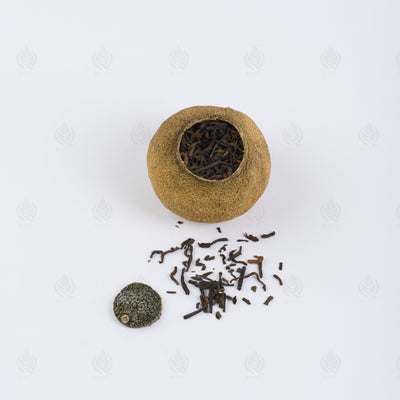
Paired with dried mandarin peel, the 陈皮 (chénpí) that the Cantonese age for years like a treasure, it takes on a scent of ripe citrus, at once lively and enveloping.
It is a cup made for thresholds: you steep it a little longer, drink it a little more slowly, and watch the frost melt in the sun.
To discover
A single cup, to greet the frost.
Black tea with mandarin peel - 陈皮红茶 (Hong Cha Chen Pi), a specialty of Xinhui in Guangdong, comes as a small hollowed-out mandarin, filled with black tea and dried with it for several years: the peel scents every leaf, and the amber liquor smells of ripe citrus.
With Shuāngjiàng, Metal fades and autumn comes to an end.
For now, there remain the morning frost and the steam of a cup: autumn has well deserved a gentle farewell.
On 7 November, the Beginning of Winter (立冬 Lìdōng) will open the season of Water, the season of drawing in, of hearty dishes and of the hearth.
Until then, one last autumn stop awaits us: goji berries, little rubies gathered until the first frosts.