

Poria (Pine sclerotium)


Hoelen / Tuckahoe
茯苓Fu Ling·Poria (Sclérote de Pin)
Poria Cocos
- Specialist suppliers based in France
- Dispatched within 24/48h, packed to order
- Kept away from light and moisture

Earth Phase 土
Ziziphus jujuba
Wu Qijun, Zhiwu mingshi tukao, 1848
According to the classical texts
利水渗湿 健脾 宁心安神
Pinyin
Li Shui Shen Shi · Jian Pi · Ning Xin An Shen
Overview
Fu Ling is not a plant but a fungus, more precisely the sclerotium (the underground resting form) of Wolfiporia cocos, which develops on the roots of pines, sometimes several metres below the surface.
Harvested all year round, stripped of its black rind, then cut into cubes or thin slices of a translucent pinkish white, it gives off a very mild scent and an almost neutral savour.
The tradition distinguishes several parts: the white flesh (Bai Fu Ling, the most common), the reddish layer near the rind (Chi Fu Ling, read as closer to the register that frees the fluids), and the heart surrounding the root (Fu Shen, closer to the register that quiets the Spirit).
Not to be confused with Tu Fu Ling (Smilax), which is a different plant.
Traditional uses
One of the most used herbs of the whole Chinese pharmacopoeia (Bensky places it in the “top 10”).
Traditionally used to carry off Dampness gently, within the register of the Earth Phase, and to quiet the Spirit gently.
Its mildness and its neutrality make it suit almost every constitution and every pairing.
Preparation and traditional-use quantity
- Decoction: 9 to 15 g, simmer for 30 minutes
- Si Jun Zi Tang: the foundation of the Earth Qi with Ren Shen, Bai Zhu and Gan Cao
- Liu Wei Di Huang Wan: one of the six components of the queen blend of the Water Yin
- In cooking: cubes simmered in Cantonese sweet soups, congee and traditional desserts
- Bai/Chi/Fu Shen distinction: Bai (white flesh) for general use; Chi (red layer) frees the fluids more; Fu Shen (heart) quiets the Spirit more
Precautions
To be used in moderation in cases of deficient with marked dryness (its freeing action can add to the dryness).
In the same family


Red azuki bean
赤小豆 · Chi Xiao Dou
6,80 €

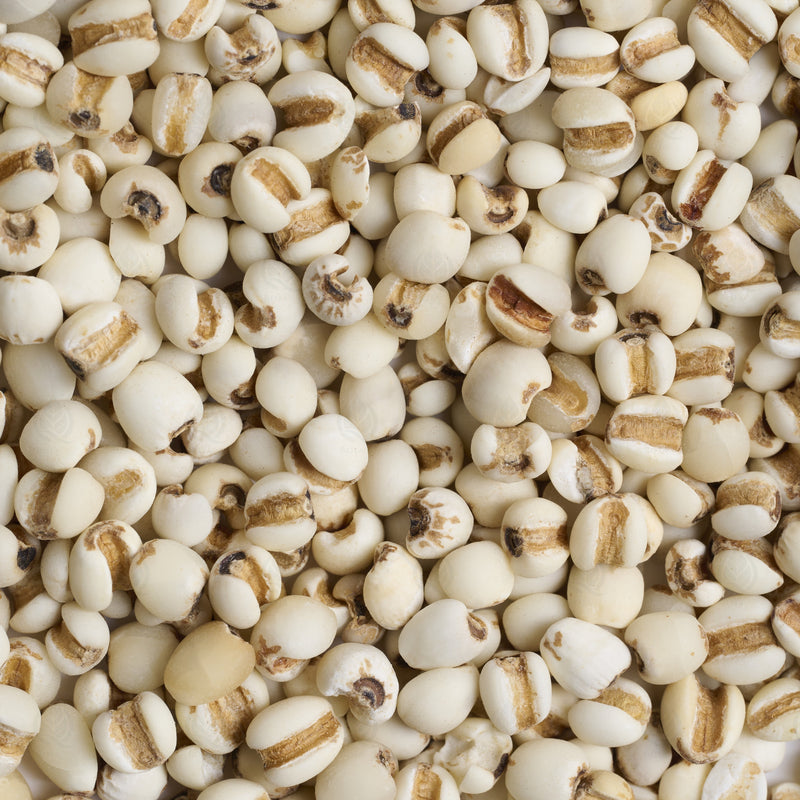

Job’s tears (Coix)
薏苡仁 · Yi Yi Ren
4,00 €