There is a day, around 23 September, when the sun rises and sets twelve hours apart, or nearly so: day and night stand equal.
The Chinese tradition names this tipping point 秋分 Qiūfēn, the “Autumn Equinox”, and lends it a particular flavor: that of a brief equipoise, before the night begins to prevail.
The point of equipoise
Fēn (分) is “to share, to divide”: the equinox cuts autumn into two equal halves and shares out the day in equal parts of shadow and light.
Past this threshold, the scales tip: the nights lengthen, the coolness gains ground, the luminous Yang of summer gently gives way to the rising Yin.
Qiūfēn still belongs to Metal (金 Jīn), that autumn Phase which loves clarity and measure, and the equinox is perhaps its purest expression: an instant of perfect poise, which nature only passes through.
Gathering and sorting
At this time of year, the tradition observes one gesture: gathering and sorting.
The harvests come in, jars are filled, things are put away, the essential is kept and the rest set aside, in the granary as within oneself.
This clarity that puts things in order is the very nature of Metal: it sorts through foods as it sorts through thoughts.
The equinox thus invites a kind of gathering inward, an expression that speaks at once of the harvest one brings together and of the attention one draws back within, as the evenings draw in.
It is no accident that so many cultures set their harvest festivals in autumn: the gesture of bringing in the fruits of the earth and that of coming home into oneself spring from the same movement, that of a world gathering itself together before it folds shut.
The culture of autumn tea
Autumn is also, for those who love tea, a season of plenty.
At this time the tea bushes yield a prized harvest, “autumn tea” (秋茶 qiūchá), renowned for its deep and lingering fragrances.
It is the time of teapots brought back out, of infusions drawn out longer, of the slow gestures of gōngfu chá, in which water, steam and aroma set the rhythm of the afternoon.
To drink autumn tea is to keep to the measure of the season: hot, unhurried, attentive to what each infusion reveals.
Around the full moon
The equinox lies close to one of the loveliest festivals of the Chinese calendar: the Mid-Autumn Festival (中秋节 Zhōngqiūjié), celebrated at the full moon of the eighth lunar month.
Families come together, share mooncakes (月饼 yuèbǐng) as round as the orb itself, and drink tea under the clear sky, contemplating the fullest moon of the year.
It is a festival of reunion and gratitude, a perfect echo of the gesture of the equinox: gathering in not only the harvests but also one’s own around the same table.
The roundness of the moon, the roundness of the cake, the roundness of the tea bowl: everything, that night, speaks of the circle and of return.
Worth discovering
Two teas to accompany the equinox.
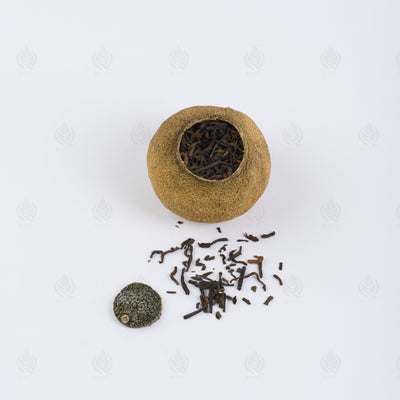
Black tea with mandarin peel - 陈皮红茶 (Hong Cha Chen Pi) weds the warmth of a red tea to patiently aged citrus: a round and fragrant cup, made for afternoons that grow shorter.
And Tie Guan Yin oolong tea - 铁观音 (Tie Guan Yin), the famous “Iron Goddess of Mercy” from Anxi, a semi-oxidized blue-green tea with notes of orchid and toasted almond, whose leaves unfurl and can be infused several times over: a tea of conversation and patience.
Once the equinox has passed, the light declines for good and the coolness asserts itself.
October approaches, with its colder dews and the drawing in of Metal; but before we come to it, let us pause over a sweetness that reigns over this autumn: monk fruit.
That will be our next port of call.